

Comparing Popular Continental Tires for Triathlon Racing
Continental is our best selling tire brand at Tri Town. We’ve found that across road, gravel and mtb, Continental consistently delivers rubber that strikes the perfect balance between speed and durability.
The past few years Continental has made notable additions on the road side of things building on the success of their popular GrandPrix 5000 with the release of 4 new tires:
- GrandPrix 5000 All-Season: A beefed up version of the original GP 5000 with an extra layer of rubber compromising speed but bolstering puncture protection. Designed to be a durable all weather training tire that comes in widths all the way up to 35mm making it suitable for light gravel and cobbles.
- GrandPrix 5000 TT: A lighter, faster version of the GP 5000 S TR. Designed for time trials, hill climbs, and anyone looking to fully optimize the bike split of an event even at the sacrifice of some puncture protection.
- Aero 111: A specifically designed front tire with an aerodynamically optimized profile. Cavities on the tires surface minimize drag and turbulence from the entire wheel-tire system, while improving handling in crosswinds.
- Archetype: A limited edition tire developed with Tadj Pogacar and world tour team UAE Emirates. A faster and lighter version of the original GP 5000 with a claimed weight savings of 35g/tire.
- GrandPrix 5000 S TR: The staple tubeless road tire from Continental that has been used as a benchmark for every other tire in the industry. The GP 5000 S TR brings the speed with as little compromise to puncture resistance, grip, and durability as possible.
While we’re grateful for these innovations that are bringing new tires to the market, it has also drastically muddied the water when it comes to tire choice for road and time-trial applications. While things have been slow here at the shop I’ve decided to review the data and crunch the numbers to hopefully un-muddy the water and make tire choice a little easier for your next event.
Ground Rules
- All the data I will be using is from Bicycle Rolling Resistance (BRR,) for additional info on their testing procedures visit their website.
- Selected tires are in as similar of sizes as possible to avoid differences in tire volume influencing results.
- All tested tires are tubeless at the same air pressure. Bicycle Rolling Resistance does not specify exact psi, only benchmarks of high/medium/extra high etc.; displayed data is from high psi. (My guess would be around 75-80 psi)
Rolling Resistance (lower is better)
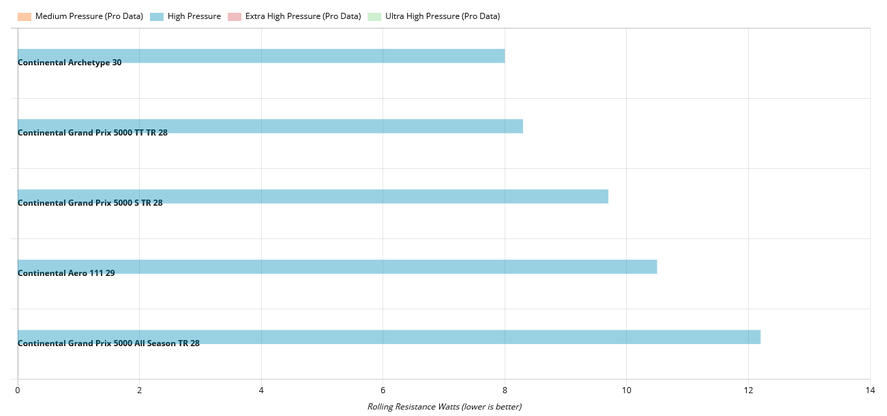
Rolling Resistance in Watts. (lower is better)
- Archetype: 8
- GP 5000 TT: 8.3
- GP 5000 S TR: 9.7
- Aero 111: 10.5
- GP 5000 AS: 12.2
At first glance, the data from the rolling resistance tests shows just what you’d expect based on Continental's claims. The Archetype edges out the TT by 0.3 watts, becoming the brand's fastest tire and the third fastest tire overall in Bicycle Rolling Resistance’s tests. On the other end, the All-Season tests the slowest, which is to be expected from a mixed condition tire, so no surprises there either. Where my interest piques with the rolling resistance test is the Aero 111 is almost a full watt slower than the original GP 5000, and over 2 watts slower than the TT. It’s still competitive as a racing tire when compared to competition, but given how hard it is to quantify wind tunnel tests and ride feel, it's hard to pick it as a clear favorite over the TT.
Continental claims in their joint testing with DT-Swiss that the Aero 111 can actually generate anywhere from 0 to 10 watts of propulsion power depending on the conditions. There is little clarification given, though, about what the “goldilocks” conditions are that would allow the tire to perform so well. In all likelihood, the aero savings from the 111 will fall to the lower end of that spectrum in 90% of conditions. An Independent test from windtunnel experts in the UK found at the most common yaw angles (the angle of the wind direction relative to the rider) the Continental Aero only saved around 0.2 watts over the TT. More -HERE-
Weight
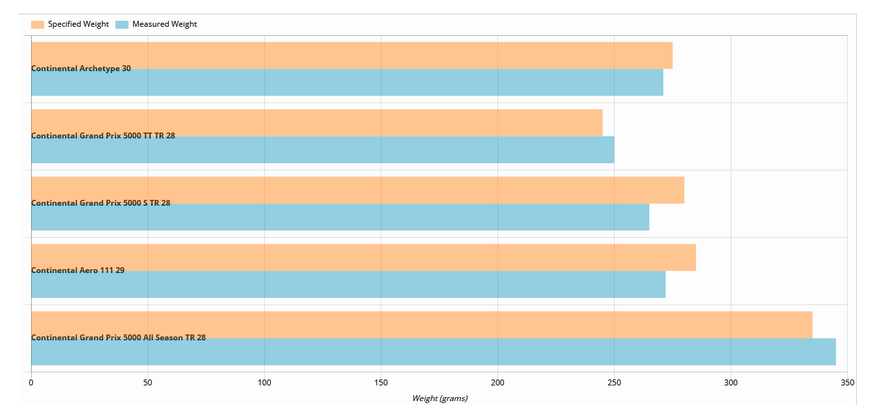
Measured Weight In Grams
- GP 5000 TT: 250
- GP 5000 S TR: 265
- Archetype: 271
- Aero 111: 272
- GP 5000 AS: 345
The weight test features both specified (as found on the companies website) and measured weight to account for variations in the tested samples. For this comparison I focused on the measured weight gathered by BRR.
The weight comparison is where minor differences in tire size start to play a factor, specifically for the Archetype which is only offered in 30mm. The tested Archetype measured 6 grams heavier than a surprisingly light 28mm GP 5000, which came in 25 grams lighter than the specified weight. That being said, comparing the Archetype to the GP 5000 in the 30mm width does confirm Continental's claims of a lighter weight tire even if it’s not on par with their generous 35g/tire.
Overall the results are once again not a surprise, the burlier All Season tire tested heaviest breaking the 300 gram mark while the other more race focused tires fell in the mid/upper 200 grams. The lightest tire tested was the GrandPrix TT putting up another strong performance at 250 grams measured weight; this follows its 2nd place in the rolling resistance test showing it’s a strong performer. The TT is actually starting to look like a favorite especially considering it’s offered in a wider range of sizes than the Archetype with 25 and 28mm widths. These narrower widths allow it to, in theory, fit a wider range of frames, especially older time-trial and road bikes that may have trouble clearing the larger Archetype.
Puncture Resistance
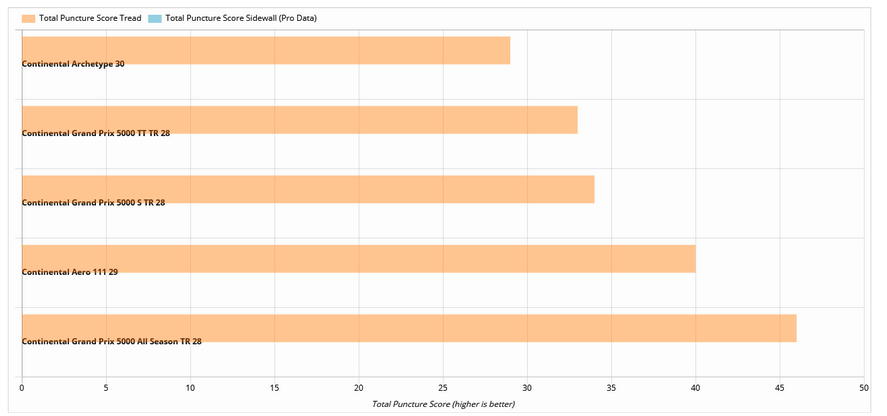
Puncture resistance score (higher is better)
- GP 5000 AS: 46
- Aero 111: 40
- GP 5000 S TR: 34
- GP 5000 TT: 33
- Archetype: 29
Now turning to puncture resistance, we see the All Season tops the list with a score of 46, again not surprising considering the tire's use case. Following suit, the Aero comes in 2nd place with a score of 40, putting it closer to the All-Season in this category than I would’ve expected for a race tire. It is impressive, but considering the higher-than-average rolling resistance, there is a clear tradeoff. What I find most interesting in these results is the small margin between the TT and the regular GP 5000; for how much lighter and faster the TT tests I would’ve expected a greater reduction in puncture protection. The TT only scores one point lower than the classic GP 5000; 33 compared to 34, and considering the data we’ve seen thus far, this slight tradeoff might be worth it. It is important to note however that this result could be due to a variance in the tire casing, we already saw the tested sample of the TT come in over Continental's specified weight for the tire so perhaps the sample used by BRR has a slightly thicker rubber than its siblings. I for one, would not be surprised if retesting a different sample resulted in slightly altered results.
Finally turning to the bottom-scoring tire of the puncture test, the Archetype with a score of 29 may look like a loser, but compared to tires with similar rolling resistance, it performs quite well. Comparable tires from Schwalbe and Vittoria within 2 watts of the Archetype in rolling resistance come out 4-5 points below it on the puncture test. Showing once again, Continental knows how to strike the balance between speed and durability better than most brands.
Wet Grip
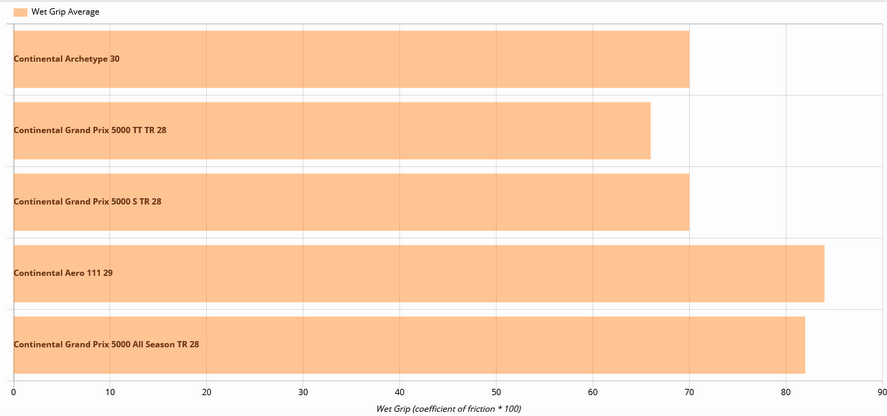
Tire wet grip average (combined scores of center and edge)
- Aero 111: 84
- GP 5000 AS: 82
- GP 5000 S TR: 70
- Archetype: 70
- GP 5000 TT: 66
The last test we’ve yet to look at is the Wet Grip test, the presented data being an average of the wet grip center and edge tests available individually by pro members of BRR.
The Aero 111 takes the crown on the wet grip test, a huge win for this tire which even out performs the All-Season! A tire I would’ve preemptively given the edge to. This is highly intriguing as it’s not exactly clear where the 111 gets all this grip from; aside from the concave slots on either side of the tire, there is virtually zero tread. Most likely the answer lies somewhere in the rubber compound.
Continental states the Aero uses the same Black Chili compound and Vectran Breaker anti puncture strip as the GP 5000 but I suspect there’s more to it than they’re letting on. In their initial review of the Aero 111 -HERE- Bicycle Rolling Resistance theorizes based on their testing of Continental's other road tires, that there are two different variations of the brand's Black Chili compound. One they’re calling “speed” and the other “grip.” Based on the Aero’s test results of high grip but relatively low rolling resistance (compared to other tires with grip compound like the All-Season) BRR suspects that the tire might use a new rubber compound that is a combination of both the Black Chili speed and grip. If this is true, it’s exciting as we can probably expect more Continental tires with this compound in the future!
The Bottom Line
While these test results are informative, they also cannot replace real-world experience; there are simply too many variables in play. It’s important to keep in mind that Bicycle Rolling Resistance’s tests represent a snapshot of how a tire COULD perform under perfect circumstances. Rather than ramble on anymore, here are some of my thoughts on the different use cases for these tires. At the end of the day, it is up to you to decide.
The Continental Archetype:
- Offers slight improvements over the original GP 5000 S TR in all categories, except puncture resistance, where it does suffer.
- Good option if you want a race tire like the TT in a slightly wider size for more comfort and control.
- 30mm width may not fit all frames, though
- Best Use Case: Racing on smooth roads with low risk of punctures and you want the fastest ~30mm tire possible
- The one downside is that, for the moment, it appears Continental is sticking to their word of these being limited-edition tires, as availability is sparse.
The Continental GP 5000 TT:
- Almost matches the Archetype in rolling resistance while having lower weight and better puncture resistance.
- The biggest shortcoming is wet grip, the lowest of all tires.
- Offered in two narrower sizes, 25 and 28, which are better suited to TT bikes and other frames with tight clearance.
- Best Use Case: You want a lighter and/or narrower race tire than the Archetype on a dry course where the surface and handling is predictable.
Continental GP 5000 S TR: (The OG)
- Solidly middle of the road in all tests.
- Offered in the largest variety of sizes: 23, 25, 28, 30, 32
- Best Use Case: You want one set of tires to rule them all (and in the darkness, bind them) for all your training and racing.
Continental Aero 111:
- Offered in a narrow size range of 26 and 29mm
- Slightly higher rolling resistance and weight than the other race tire options.
- Makes up for shortcomings in other categories with exceptional puncture resistance and wet grip
- Aerodynamics X-factor that, under the right conditions, could save up to 10 watts and improve handling in crosswinds
- Best Use Case: A good front tire offering improved handling in difficult conditions when a little rain and/or wind is in the forecast. Could be paired with a TT, GP 5000, or Archetype in the rear, depending on needs.
GP 5000 All-Season:
- Offered in all sizes up to a plus-sized 35
- Best combination of wet-grip and puncture resistance in the tests
- Competitive rolling resistance for an all-round tire when looking at options from other brands
- Best Use Case: Go-anywhere tire for training that still uses the Black Chili compound, providing great grip and speed. Great for a rider who prioritizes good puncture resistance but still values decent speed and ride feel. The wider 35mm width also has potential as a competitive gravel race tire for hard-packed dirt paths and roads.


